
Have you been wondering if microsuction is safe?
Like any procedure in the ear canal, microsuction carries some risk, and it should only be performed by a practitioner trained in its use. Learning how to perform microsuction requires both a period of study and an extensive practical placement; it is not a procedure that can be learned online or within a day. Practical training in Australia currently can be difficult to source as the technology is relatively new outside of specialist services, and there are limited practitioners with enough experience to teach.
Read on to discover more about this advanced technology and the Earworx training program.
What is Microsuction?
The microsuction ear cleaning technique is similar to a tiny vacuum within your ear, used to remove hard and built-up earwax via suction. It is a dry technique, with no water involved. Your nurse will assess whether it is suitable if you have a perforated eardrum, grommets or a current ear infection. There is no need to apply pressure to your ear canal or drum for wax to be removed as trained practitioners are taught the technique of applying suction only to the wax, and never to the canal wall or drum.
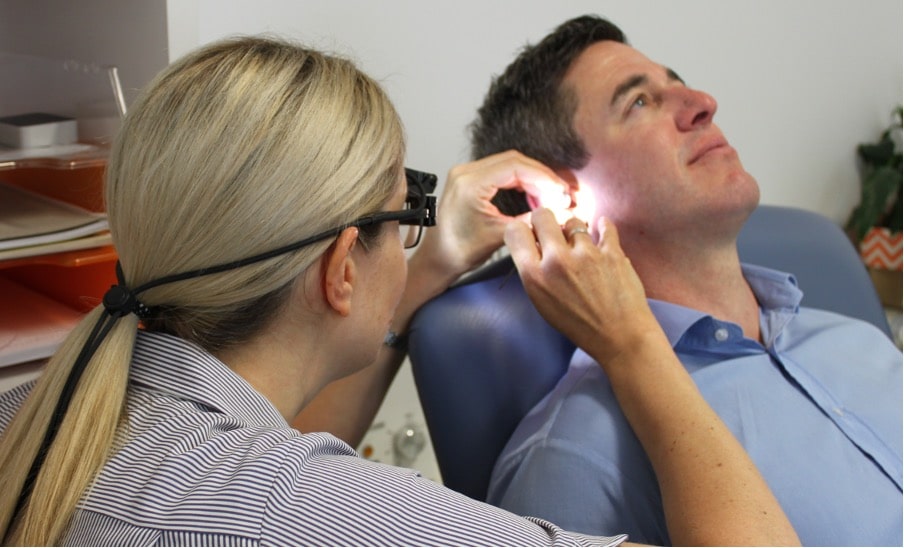
Earworx nurses across the country use microsuction to remove earwax for hundreds of patients every day. Your Earworx nurse wears a magnifying glass with a bright light to directly observe your ear canal and drum during the procedure, enhancing safety.
What ENT practice guidelines say
Microsuction and ‘curettage’; the additional use of fine instruments such as a curette or forceps; is the earwax removal method preferred by Ear Nose and Throat (ENT) specialist doctors. If you visit an ENT, this is the technique they will apply to remove any excess wax, debris related to infection or foreign bodies.
Operated by Experienced, Trained Professionals
Because microsuction is advanced technology and requires both specialised equipment and practical training, it is not available in all places that offer ear clearing services. Earworx has worked diligently over many years to create both a nationally accredited theoretical Earworx Course in Aural Care and an extensive practical course in microsuction and curettage, which is currently only available to registered nurses working within the Earworx network. All Earworx registered nurses are trained and assessed as competent to perform this procedure, which is done with the ear canal and eardrum under direct view.
Earworx nurses take your ear history, explain the procedure to you prior to commencing, check in with your comfort levels during the procedure, and provide you with education at the end of the appointment. Questions such as ‘why did this happen to me?’ and ‘how do I stop this happening again?’ are questions all Earworx nurses are trained to answer.
Visualise the Ear Canal
Our ears are very delicate parts of our bodies. Earworx nurses are trained in microsuction technique and directly observe your ear canal throughout the procedure.
Comfort
Every Earworx nurse is taught techniques for avoiding the canal wall and eardrum, because the ear canal is very sensitive. Your nurse will check your comfort throughout. There is no pressure applied to your eardrum by water as microsuction is a dry technique. It is very important you provide your Earworx nurse with a thorough history at the commencement of your appointment and keep your head still throughout the procedure.
You may experience a temporary itchy sensation inside the ear as your earwax is removed, and your nurse will check your comfort throughout. If you find the procedure a little disconcerting due to the noise of the vacuum in your ear canal, you just need to chat to your friendly Earworx nurse who will work with you to overcome this, either by reassurance, using a smaller vacuum, or even using fine instruments as an alternative. The Earworx goal is to make your visit as comfortable as possible, so don’t hesitate to chat to your nurse if you have any questions; they love questions because they love talking about all things ears!
Quick and Efficient
An Earworx appointment runs for 30 minutes but the procedure itself is quite quick. When you are invited into the Earworx consultation room, you will be asked about your ear and wax history, the procedure will be performed (this can be completed in as little as 10 minutes), and you are provided with education at the end. So whilst the scheduled time is 30 minutes, Earworx nurses often have you away earlier. If your earwax is particularly hard and impacted, nurses may suggest softening and returning for a return visit in a week’s time for removal.
Who microsuction may suit
Unlike water syringing or flushing, microsuction is a dry technique, so it may be an option for people with ear conditions that mean they should not have water in their ears. If you have a perforated, or non-intact eardrum, you have grommets, you suffer from outer ear infections, or you are a diabetic (and therefore more prone to infection) microsuction is recommended for you. Because microsuction uses small instruments and suction rather than water, your nurse can assess whether it is suitable for those ear conditions.
Microsuction can be used with people who have exostoses or ‘surfers ear’ and prefer not to have water in their ears. Earworx sees children over four years old, older patients and people who use hearing aids. Your nurse will assess whether microsuction is suitable for you.
When to use Microsuction
Earwax is a naturally occurring substance which is actually good for our ears; it helps to both protect your ears from infection and keeps them clean by catching dust and dirt prior to it heading down the ear canal. It is produced continually but is normally carried out of the ear by a ‘conveyor belt’ motion of the skin layer. Wax often falls out of the ear without us even noticing! But sometimes too much wax is produced, or wax catches too much dirt, and earwax build up results. If you are suffering from excess or impacted earwax, you should consider microsuction.
You may not know that you have excess or impacted ear wax until someone actually looks into your ears e.g. your GP or an audiologist. Common symptoms of impacted earwax include a blocked or full sensation inside your ears, itching, pain (earache), or even a ringing sound known as tinnitus. More serious symptoms include dizziness or vertigo, and loss of hearing. If your ears block after swimming or bathing, this is also a tell-tale sign of excess wax.
The symptoms of impacted and excess earwax can be very uncomfortable and sometimes painful for sufferers. If you do produce a larger amount of earwax, or use hearing aids, it is recommended that you have your ears checked for impacted wax regularly.
Summary
Microsuction should only be performed by a practitioner trained in its use. Always ask your practitioner about their level of training. All Earworx nurses complete study and a practical placement so they can assess earwax-related symptoms, remove built-up earwax, and educate you on caring for your ears.